


Introduction to Health Insurance in the USA
Health insurance plays a very crucial role in healthcare in the United States. The healthcare issue [How Health Insurance Really Works in the USA] is the bane of millions of American lives, as a lot of people do not understand how the coverage, costs, and benefits work. In simple terms, health insurance can save people the danger of being financially burdensome due to medical bills and also get the necessary care. The insurance plans differ in terms of type, provider, network, and an individual needs to know the different premiums, deductibles, copays and the coverage requirements. With the understanding of these basics, people can make good decisions and prevent those medical costs that are difficult to foresee.
Health Insurance Plans.
It is necessary to know the different categories of health insurance programs. The plans have their own rules, cost, and network limitations, therefore, to choose the right plan, one must consider their needs in healthcare.
HMO (Health maintenance Organization)
- Network: It compels the members to utilize in-network providers.
- Primary care physician (PCP): This is required in order to make referrals to specialists.
- Advantages: reduced premiums, integrated care.
- Cons: Reduced provider options, reduced flexibility.
Over latest post:How Personal Loan Interest Rates Are Calculated in the USA 2026

PPO (Preferred Provider Organization)
- Network: Provides in and out of network coverage.
- Referrals: No referral was required to visit a specialist.
- Advantages: flexibility, a broad selection of providers.
- Disadvantages: The increase in premiums and out-of-pocket expenses.
EPO and POS Plans
- EPO: No PCP required, in-network only, just like HMO.
- POS:Combination of HMO and PPO; PCP will be needed, out-of-network is possible.
Government-Sponsored Insurance
- Medicare: Federal program of 65 or some disabled persons.
- Medicaid: State and federally-funded program of low-income families.
- CHIP: Incomes of families with a middle income are covered.
The crucial Health Insurance Terms described.
- Premium: Monthly payment in order to remain covered.
- Deductible: This is the amount that has to be paid before the insurance begins to cover costs.
- Copay: Particular amount paid per given services.
- Coinsurance: Percentage of amounts paid after deductible.
- Out-of-Pocket Maximum: This is the maximum you have to pay in one year after which the insurance covers 100%.
Determination of Premiums and Costs.
Premiums charged by insurance companies are determined in a number of factors:
- Age, gender, location
- Tobacco use
- Plan type and coverage level
- Family size
- Medical history (sometimes)
Knowing these factors can assist in determining which plan can be the most economical yet cover you.
Over latest post:The credit scores work in the USA (2026 Guide)
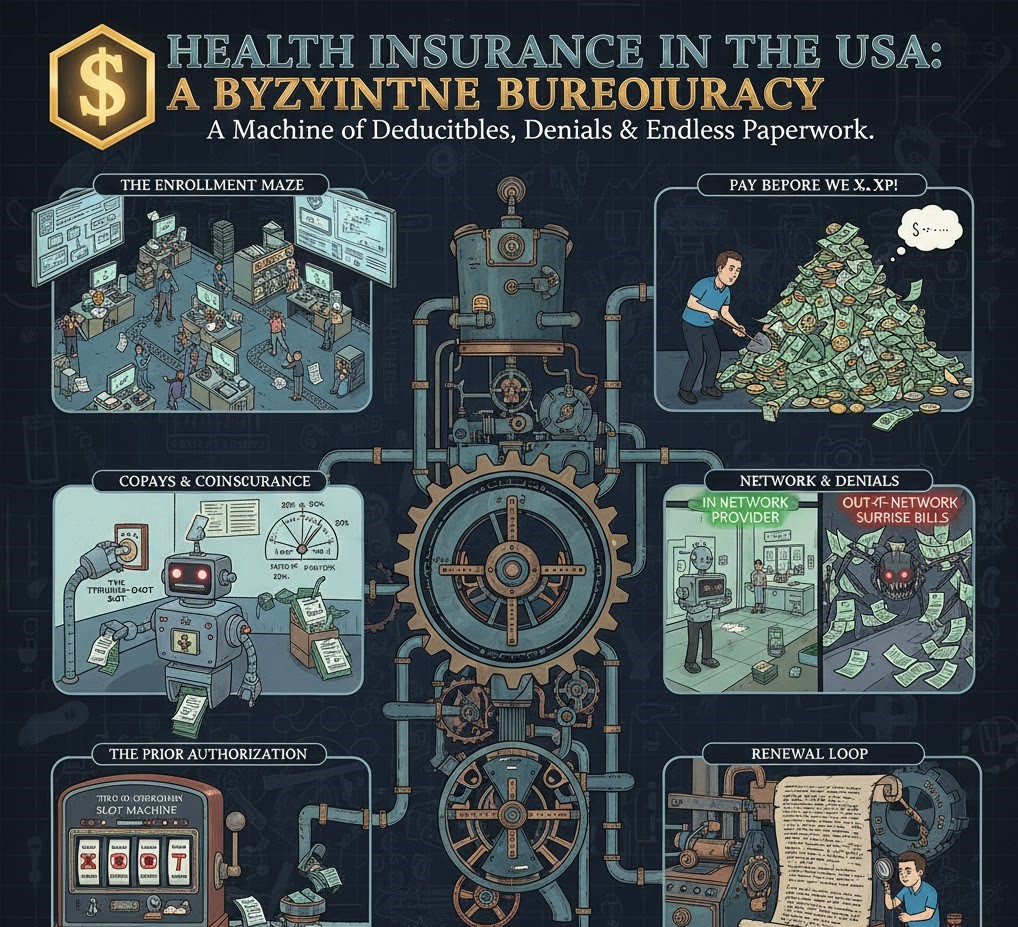
The Question of Which Health Insurance is Right.
- Determine Needs: analyze past medical history, prescriptions and future procedures.
- Compare Costs: Contemplate premiums, deductibles, copays and out of pocket limits.
- Check Networks: Secure the preferred doctors and hospitals.
- Review Benefits: Find preventive care, maternity, mental health, and specialist visits.
The process of Health Insurance Claims.
- Receiving Care: See an in-network provider.
- Claim Submission: This is when a provider adds a claim to your insurance.
- Explanation of Benefits (EOB): This is a statement that you get which shows the covered services and what is due.
- Payment: Insurance is paid by the provider; you are paid copay or coinsurance.
Prevention and Health Insurance.
The Affordable Care Act (ACA) covers a great number of preventive services:
- Vaccinations
- Cancer screenings
- Annual wellness visits
- Prenatal care
The services prevent a rise in long-term expenses as a result of early detection of problems.
Common Mistakes to Avoid
- Selecting plans only according to the amount of premiums.
- Ignoring provider networks
- Disregarding deductibles and coinsurges.
- Not reviewing changes of annual coverage.
Health Insurance Benefit Maximizing Tips.
- Telehealth services should be used when possible.
- Select generic prescriptions.
- Be involved in wellness programs.
- Arrange preventive treatment once a year.
Special circumstances Health Insurance.
- Self-insured: Think about subsidized Marketplace plans.
- Students: University or young adult plans are affordable.
- Chronic condition: Find plans with full specialty cover.
- Families: Family plans will save money per-capita and provide coverage.

Frequently Asked Questions
What is the distinction between the HMO and PPO?
HMO is based on in-network providers and PCP referral with PPO based on out-of-network care and no referral.
How does Medicare work?
Medicare covers the elderly and some of the disability, in various components that cover hospital, medical and prescription services.
Is it possible to switch insurance every now and then?
Mostly, modifications are permitted in the Open Enrollment Period, or subsequent to qualifying life events.
What is an out of pocket maximum?
It is the sum total that you will pay every year before the insurance will cover all costs 100 percent.
Are the preventive services free of charge?
Yes, some of the preventive services are completely covered as ACA-compliant plans.
What can I do to know whether a doctor is in-network or not?
Visit the network directory of your insurance provider, or contact the office of the provider.
Conclusion
The knowledge [How Health Insurance Really Works in the USA] allows one to make the right choices, spend less, and receive quality care. With the knowledge of the types of plans, costs, networks, and preventive benefits, you can maximize the coverage and prevent unwarranted expenses. Having your plan reviewed on a regular basis would make sure that it remains suitable to your changing healthcare requirements.